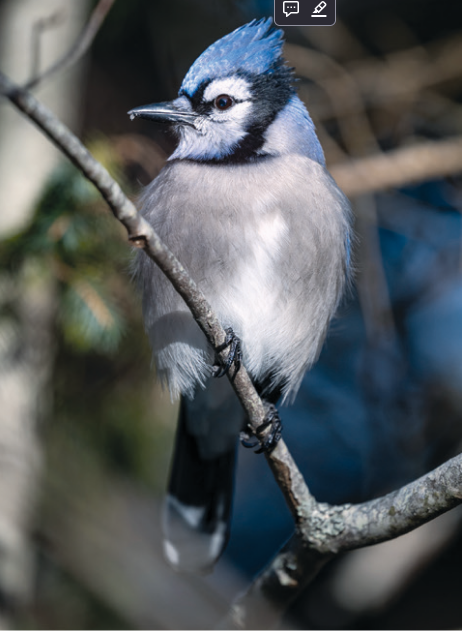
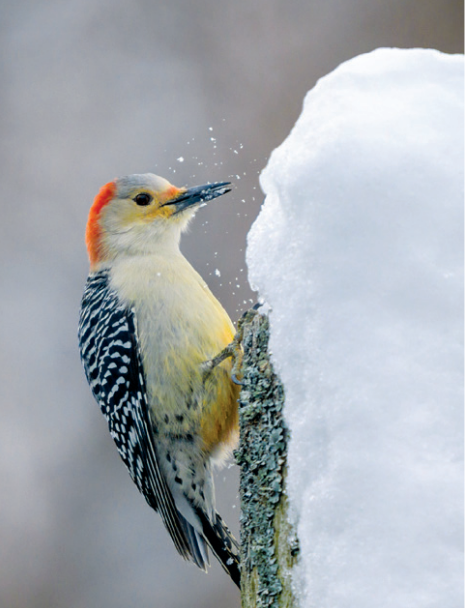
I always feel a little sad when migratory birds head south for the winter. But birding during the colder-weather months can be wonderful, too. With reduced leaf cover, it’s often easier to spot birds. Also, flashes of colourful plumage are even more beautiful against the softer colour palette of winter.
There’s not much good to say about climate change, but longtime birders may point to the fact that milder winter temperatures mean there are now more birds to enjoy during the winter.
That leads to an often-debated question: should we feed the birds in winter?
One school of thought is that doing so reduces natural foraging behaviours and creates dependence on human intervention—potentially even encouraging migratory birds that might otherwise have left to stick
around over the winter. That, in turn, may further reduce the winter’s more scarce food supply for non-migratory birds.
While those arguments have been disputed by those who say feeding birds simply provides much-needed wintertime supplementation of their regular, natural food sources, there is no disagreement among bird experts about things we should do to keep birds safer if we do decide to put up feeders.
Hang feeders near some shelter: It’s a fact that predators will learn that feeders also offer them more food opportunities.
But you can reduce the risk of your feeder becoming local predators’ songbird buffet by hanging the feeder near or on a tree or beside shrubbery that provides some cover and a quick escape route. And keep your cat indoors.
Buy good-quality food: Sunflower seed in the shell is loved by many birds. Safflower seeds are also popular, and suet cakes will be appreciated by chickadees, woodpeckers, nuthatches, and others. Less-expensive mixed feed usually contains red millet and other fillers that many birds won’t eat. Commercial suet cakes also often contain fillers.
If you want to give birds a treat, there are lots of recipe online for more nutritious homemade suet cakes.
Uneaten food can become moldy or rancid, promoting disease and attracting rodents and other pests, so offer only what the birds like, and clean up uneaten food quickly. Never offer bread, which is junk food for
birds, including ducks.
Clean feeders often to reduce the risk of disease: When the weather is dry or below zero, clean feeders once every 12-14 days. If it’s rainy or routinely above 3 degrees Celsius, clean feeders at least once a week. Use one part household bleach to nine parts water for cleaning, rinse well, and dry thoroughly before refilling.
Pay attention to avian disease advisories: The Nova Scotia Bird Society and other groups share information when there is an identified disease outbreak among wild birds. In some cases, advisories will include a request to take backyard feeders down to mitigate the spread of disease.
For more information about being a wintertime bird supporter, visit sites maintained by Birds Canada, Nature Canada, the Nova Scotia Bird Society, and others.
by Laura MacKinnon
A note about squirrels
Laura MacKinnon
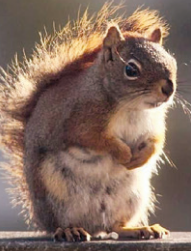
If you feed birds, you will also get squirrels.
There are lots of bird feeders around that are described as being squirrel
proof. And there are lots of photos and videos of squirrels breaking through
those feeders’ defenses to enjoy a good meal. Even if squirrels can’t get into a
feeder, most birds are not tidy eaters, and squirrels will show up to clean up
whatever gets spilled.
No matter how you mayfeel about squirrels, it’s important to know that
peanuts—and peanut butter—are bad for them.
Eating lots of peanuts weakens their bones to the point of causing fractures
that ultimately make them unable to run and climb.
As a result, they end up starving or becoming prey.
Even if you’re not a squirrel fan, it’s a cruel end.
The solution is to buy bird food that doesn’t include peanuts, and avoid
homemade suet-cake recipes that include peanut butter—most of which is
also too high in sugar and salt for the birds’ health.
Plain almond butter, while more expensive, is a better
alternative, both for the birds and, especially, for
those inevitable squirrels.